What Makes a Good Song Chart?
Last time, we talked about the difference between excellence and perfection in music and how pursuing one can sometimes get in the way of the other.
Today, let's look at something much more practical: What makes a good song chart?
Start with a Shared Reference
In the studio, our number one goal is to get everyone on the same page. Whether it's musicians, producers, engineers, or assistants, nothing slows a session down faster than people working from different assumptions.
A good chart gives everyone a common reference point. Instead of wondering where the bridge starts or when the chorus repeats, the whole team can focus on making great music.
Not All Charts Are Created Equal
There are seemingly infinite ways to make a chart. Many songwriters bring lyric sheets with chord symbols written above the words. While that's a good start, those charts depend on already knowing how the song is sung. Without that context, it's often difficult to tell exactly when the chords change—and that costs valuable studio time.
Instrumental music has a different challenge. Without lyrics, chord symbols alone don't communicate the melody. That's why jazz and other instrumental styles often use a lead sheet, which combines standard notation with chord symbols.
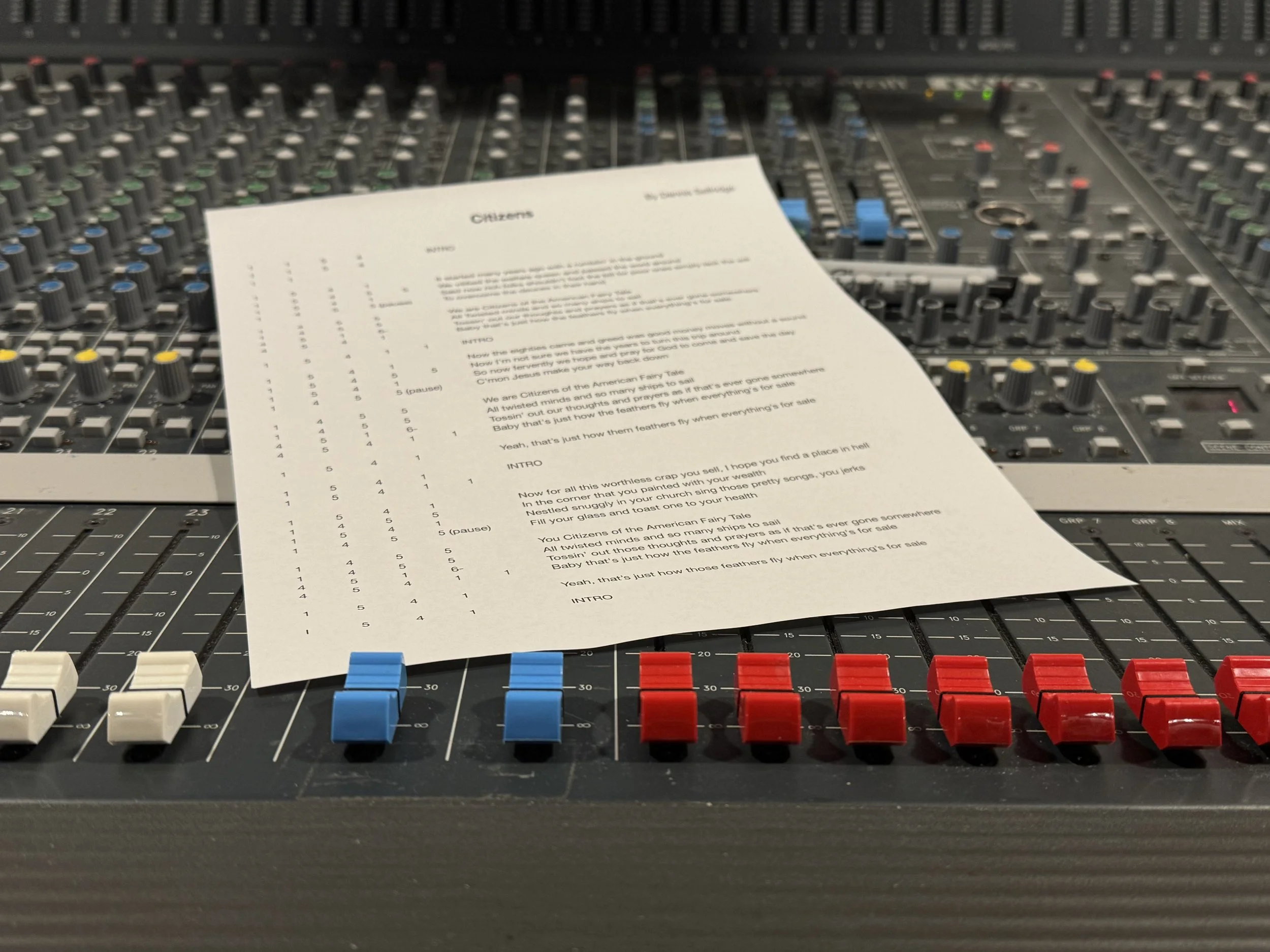
The Charts We Use
At Widget Studios, we spend most of our time working with singer-songwriters, so we assume the vocalist already knows the melody. What the band needs is a clear picture of the song's structure and the timing of the chord changes.
First, we separate the chords from the lyrics and organize them into a measure-based grid. Each chord position represents a specific unit of measurement like a whole note or half note, depending on how the song goes.
Second, we use the Nashville Number system instead of alphabet chord symbols. This allows for easier key changes. Most experienced session players can read Nashville numbers.
Lastly, we use standardized short-hand for chord types. So instead of Am, it looks like 6-. Instead of D half-diminished or Dm7(♭5), it is written 2ø. Instead of Cmaj7 — 1∆.
This gives musicians the information they need at a glance, making rehearsals more efficient and recording sessions run more smoothly.
If you are a songwriter interested in recording your song with session musicians, give us a callto discuss what you need to do to make that dream a reality.